Exploring C S Lewis blog
Shadowlands
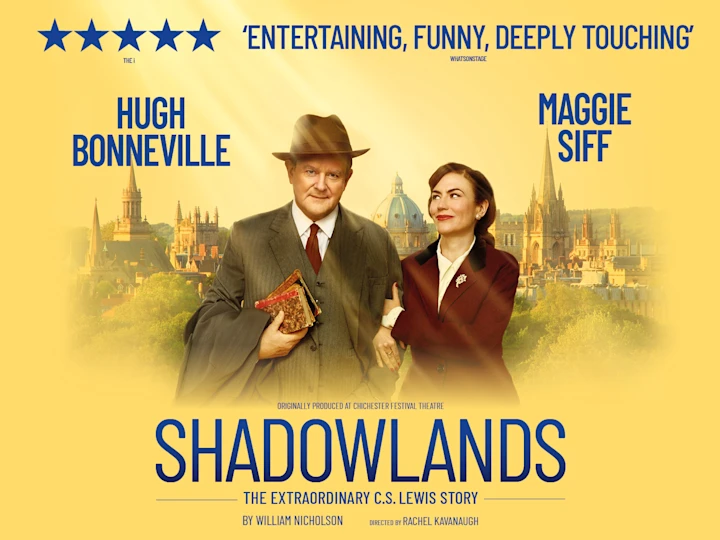
Last week I went to London to see the play Shadowlands at the Aldwych Theatre, with the wonderful Hugh Bonneville (Lord Grantham from Downton) and Maggie Siff as Joy Gresham, later Mrs Lewis.
The play itself was written by BBC documentary-maker and novelist William Nicholson (born 1948) and first performed at the Theatre Royal, Plymouth on 5th October 1989 and, less than three weeks later, in the Queens Theatre, London. The lead character, C S Lewis, was played on stage by leading English actor Nigel Hawthorne and Joy Gresham was played by Jane Laportaire. It was awarded the Evening Standard Best Play of 1990 and went on to win a Tony Award for its subsequent run on Broadway.
The play was then turned into a TV film, in 1985, directed by Norman Stone with Joss Ackland playing Lewis and Claire Bloom playing Joy. Then in 1993, Richard Attenborough directed a big-budget cinema version with Anthony Hopkins playing Lewis, and Debra Winger playing Joy. It received two Oscar nominations and two BAFTA wins (best actress for Debra Winger and adapted screenplay).
I had watched and enjoyed both films a few years ago but had never seen the play live. I was particularly interested in seeing how Hugh Bonneville would interpret the role of Lewis.
Obviously, the playwright had to concertina eight years of Lewis’s interactions with Joy Gresham in Oxford, from 1952 to 1960, into a 2-hour play. It is always challenging writing a play based on real events and staying true to the actual story. There are many inaccuracies in the play, including the fact that Joy had two children (Douglas and David), not one; when she first came to England to meet Lewis, she left both children at home with her husband and cousin Renee (they only came to England on the second visit); and her first meeting with Lewis was not with his brother Warnie: it was with her old friend Phyllis and Lewis’s friend (and later biographer) George Sayers; it omits their honeymoon in Ireland and holiday in Greece, while she was in remission; her own book on the ten commandments; her involvement in Scientology and carrying out Dianetics tests; and her input into Lewis’s literary output at the time.
The action in the play also moved very quickly from Joy, a married woman, meeting Lewis to the point where she was divorced, and he, who had no romantic interest in her at all, agreed to marry her in order to enable her and her boys to stay in England. It was a very unlikely thing for him to do and must have been an extremely difficult decision for him to make. This didn’t come across in the play.
What the playwright couldn’t have been aware of at the time of writing was that Joy had had designs on Lewis even before she met him, and she was assertive in her desire to have a romantic and sexual relationship him, but that he continually rejected her advances. Her excellent sonnets of that period, which have now been published, highlight her strong desire for him and her anger at his rejection. The true story was not quite the late life romance that Shadowlands presents.
Joy pursued him relentlessly, moving to Oxford to be close to him, persuading him to fund her children’s education, and then, astonishingly, to marry him, ‘technically’, in a registry office, from returning to lecture that afternoon. This was on her understanding that his house, the Kilns, would be inherited by her children, even though it didn’t actually belong to him. Despite the fact that Lewis had previously lived with an older woman for many years, he was completely unable to deal with a highly intelligent, assertive and manipulative woman like Joy. He found her intellectually stimulating. All his friends could see what was happening and strongly disliked her.
What the play, and biographies of Lewis, also ignore is the fact that when she moved to Oxford, he accepted a job as a professor at Cambridge, so at least five days a week, from Tuesday to Saturday, during term time, he was living 90 miles away from Joy in his Cambridge college rooms.
Everything changed with her cancer, because his Christian concern was then suddenly with an apparently dying woman who needed looking after. Did this concern then turn into romantic love? I think the evidence from a A Grief Observed, his book that described his reflections on his experiences and feelings after she died, do support the thesis that, in the end, his agape love for a dying woman did turn into something deeper: to eros.
From an Irish perspective, one of the omissions in the play is any reference to Lewis’s Belfast childhood, or any trace of an Ulster accent. Lewis was always adamant that he was Irish, not English, and visited Ireland, mainly Ulster, at least 60 times after he was sent to an English board school after his mother died.
Despite all its inaccuracies, I enjoyed the play and the performances very much. The fact that it has been turned into two successful films as well as numerous live theatre performances is an indication of how well-written the play is, bringing out the humour and pathos of the story. It also highlights Lewis’s views on why God allows pain: seeing human life on earth as only ‘shadowlands’ before the real life to be experienced in the afterlife. But it also highlighted the personal difficulties he faced, which challenged his own views.
The high calibre of actors added greatly to the enjoyment of the performance. I would definitely recommend it, despite its shortcomings.
Leave a Reply