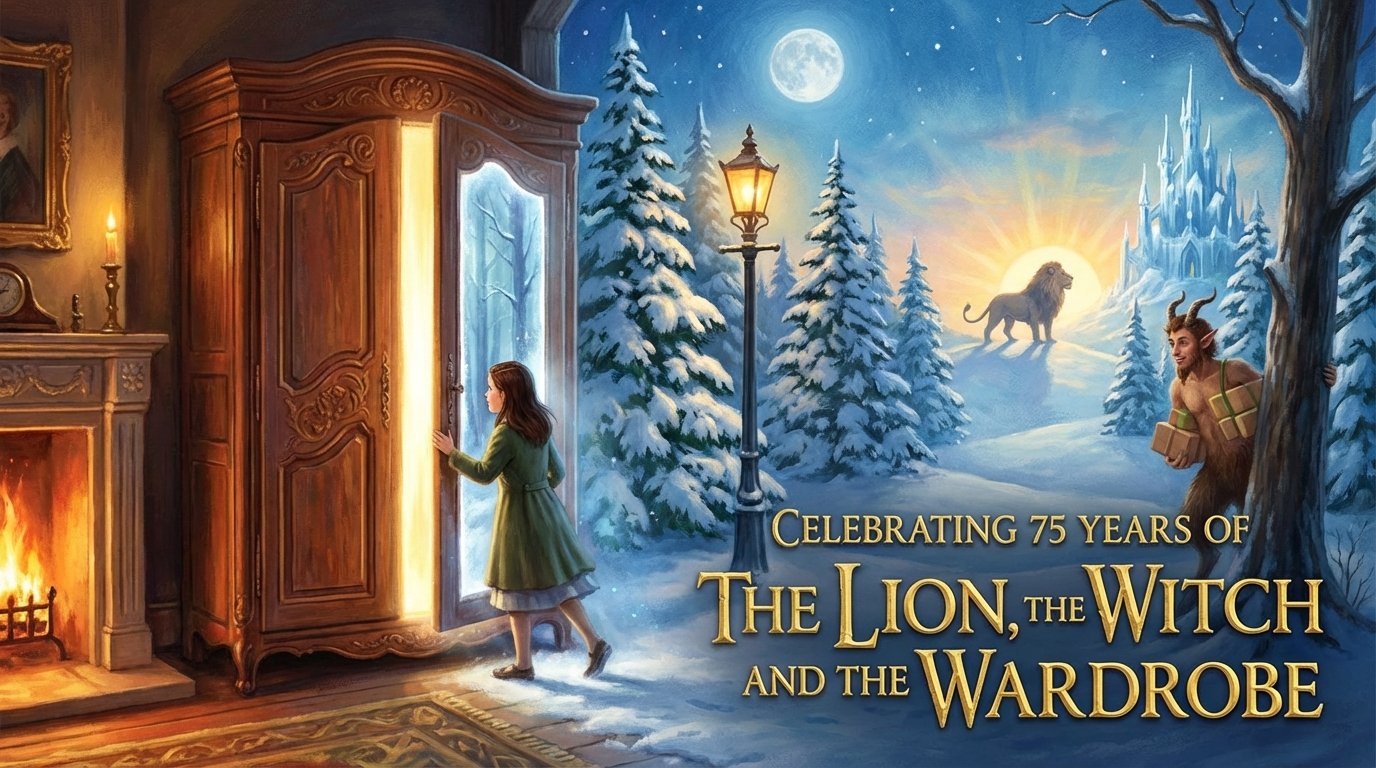
Seventy years ago, a simple wardrobe in a spare room, opened into one of the most beloved fictional worlds in literary history. The Lion, the Witch and the Wardrobe, the first-published and perhaps most iconic book in The Chronicles of Narnia series by Belfastman C.S. Lewis, made its debut in 1950. Since then, generations of readers have followed Lucy Pevensie through the wardrobe into the snow-laden forests of Narnia and been captivated by talking animals, epic battles of good and evil, and the deep, mythological and philosophical undercurrents that continue to invite both children and adults into its imaginative depths.
Now, seventy-five years on, The Lion, the Witch and the Wardrobe remains as potent and magical as ever—an enduring classic that invites us to reflect not only on the story itself but also on its origins, its legacy, and the enduring impact it has made on literature and culture around the globe. Hopefully, some of you managed to get to see the wonderful stage musical which has been touring theatres around the UK and Ireland.
From Ink to Immortality: The Story Behind the Story
When Clive Staples Lewis, better known as C.S. Lewis, penned The Lion, the Witch and the Wardrobe, he could not have imagined the cultural phenomenon it would become. In fact, its early reception was mixed. Critics were divided—some praised its imagination and charm, while others found its Christian symbolism too overt. Yet Lewis had not set out to write a moral tale. It started with a visual image of a faun carrying parcels through a snowy wood. As he famously stated, “At first I had very little idea how the story would go. I was seeing pictures in my head of all kinds of animals, the Queen on a sledge… Then suddenly Aslan came bounding in.”
That image of the faun had lived in Lewis’s imagination since he was sixteen. It was decades before that image of Mr Tumnus found its home in Narnia, but it never left him. Inspired by various myths, fairy tales, and his faith, Lewis crafted a world where good and evil are clear, but forgiveness and redemption are always possible. The war-torn 1940s also played their part; during the Blitz, Lewis took in evacuated children from London, and it is believed they helped inspire the creation of the evacuated Pevensie siblings, as well as the professor and his house.
Despite being the first Narnia book written and published, The Lion, the Witch and the Wardrobe was not the first chronologically in the series’ internal timeline (that would be The Magician’s Nephew, published in 1955). But it is undoubtedly the narrative gateway to Narnia for most readers, and arguably the heart of the series.
Stepping Through the Wardrobe: The Magic of Narnia
What makes The Lion, the Witch and the Wardrobe endure, even after seventy-five years?
At its core is the idea that ordinary children can become heroes. Lucy, Edmund, Susan, and Peter Pevensie are not extraordinary by any earthly measure – not super-heroes with special powers. They squabble, make mistakes, and struggle with fear and temptation. And yet they are chosen to fulfil a great destiny. This democratisation of heroism, where courage, love, and hope matter more than strength or birthright, is a key to Narnia’s enduring appeal.
Then there is Aslan, the noble lion who is both terrifying and tender, whose sacrifice and coming back to life form the backbone of the book. Lewis masterfully blends myth, fairy tale, moral lessons and Christian symbolism, creating a work that is at once accessible and profound. Lewis never insisted on a single interpretation of the book, encouraging readers to bring their own imaginations and beliefs to the story.
The world-building, too, was very innovative. Lewis drew on everything from classical mythology to medieval romance, Greek and Norse legend, and British and Irish folklore. Narnia is populated by fauns, dryads, centaurs, talking beavers, and a wicked White Witch who turns her enemies to stone and keeps the land trapped in “always winter but never Christmas.” J.R.R. Tolkien, who had spent many years creating his own coherent myth of Middle earth, struggled with Lewis putting all these different elements into the one story – ‘It just wont do’ he is reported as saying. The juxtaposition of cold tyranny and warm hope, however, gives the narrative its emotional thrust and sets the stage for Aslan’s dramatic return.
Layers of Meaning
The story works on multiple levels. Children can read it as a thrilling adventure, full of peril, wonder, and triumph. Adults can return to it and find deeper meaning, spiritual reflection, and philosophical nuance. It is this dual accessibility—this layered storytelling—that has helped the book remain fresh and relevant through the decades.
A Cultural and Literary Legacy
The Lion, the Witch and the Wardrobe has never been out of print since 1950. It has sold over 85 million copies and been translated into more than 47 languages. It has inspired radio plays, theatre adaptations, stage musicals, including the excellent one that is currently touring theatres in the UK and Ireland, and several screen adaptations – most notably the 2005 film by Walden Media, which grossed over $745 million worldwide.
But the legacy of Narnia stretches far beyond sales figures and box office returns. As well as its huge number of current fans who read and reread the story, there are many writers who acknowledge his influence on their own work. The idea of a magical world accessible through an ordinary portal—a wardrobe, a painting, a rabbit hole—has become a staple of fantasy literature, and Lewis helped make that possible.
For many Christians, Lewis’s work has become an enduring touchstone in the blending of imagination and faith which has helped generations of readers engage with spiritual questions in fresh and imaginative ways. Narnia is often a child’s first encounter with questions of sin, redemption, forgiveness, and sacrifice – not through doctrine, but at an emotional level through story. There are others, however, such as Philip Pullman, who strongly dislike his use of Christian symbolism in children’s stories.
Personal Journeys Through Narnia
Ask a dozen readers about their first experience with The Lion, the Witch and the Wardrobe, and you’ll get a dozen different stories. Some found the book in a school library; others were read to by a parent at bedtime. Some encountered it as teenagers or adults, amazed that they’d missed it as children. Many recall the feeling of wonder that accompanied their first step into Narnia—the crisp snow, the gas lamp, the rustling trees, the hope.
What binds these stories together is the sense that something magical and meaningful happened—something that left a permanent mark on the imagination. Narnia becomes a place readers return to not just for comfort or nostalgia, but for truth. As Lewis wrote in The Voyage of the Dawn Treader, “All things work to the glory of Aslan, and to the good of those who follow him.”
Continuing the Journey: Narnia Today
As we celebrate 75 years of The Lion, the Witch and the Wardrobe, Narnia is not only not declining with age but experiencing a resurgence. Netflix has announced a forthcoming adaptation of the Narnia series, with Greta Gerwig slated to direct. This new generation of visual storytelling could bring the magic of Narnia to millions more viewers and reintroduce the books to new readers.
But beyond the screen, the Narnia series continues to be studied, debated, and cherished. Book clubs revisit it; theologians explore its symbolism; children clutch it under their pillows. Teachers use it to introduce literary themes; pastors cite it in sermons; parents pass it on to their children.
The wardrobe door remains open.
Why It Still Matters
In a world increasingly sceptical, divided, and fast-paced, The Lion, the Witch and the Wardrobe reminds us of timeless truths: that courage can come from the smallest and gentlest among us; that betrayal can be forgiven; that evil can be overcome; and that wonder is never out of reach.Narnia teaches us to hope—not blindly, but with imagination and conviction. It invites us to believe in a reality beyond what we can see.
Seventy-five years later, we still need stories like Narnia—not just to escape, but to remember. To remember what it means to help others and to sacrifice. To remember the power of forgiveness. To remember that deep magic from before the dawn of time still moves beneath our feet, if we’re willing to believe.
In the End: Further Up and Further In
C.S. Lewis once remarked that a children’s story that can only be enjoyed by children is not a good children’s story. The Lion, the Witch and the Wardrobe proves this in spades. Its simplicity is deceptive. Beneath its clear prose and fairy-tale surface lies a moral and metaphysical richness that continues to inspire, challenge, and comfort readers of all ages.
So, here’s to seventy-five years in Narnia. To Mr. Tumnus and Turkish Delight. To the lamppost in the snow. To Edmund’s redemption. To Lucy’s faith. To Peter’s courage. To Susan’s doubts. And above all, to Aslan—who is not safe, but is good.
The story is far from over. The wardrobe still stands open. All we need is the courage to step inside.
Leave a Reply